

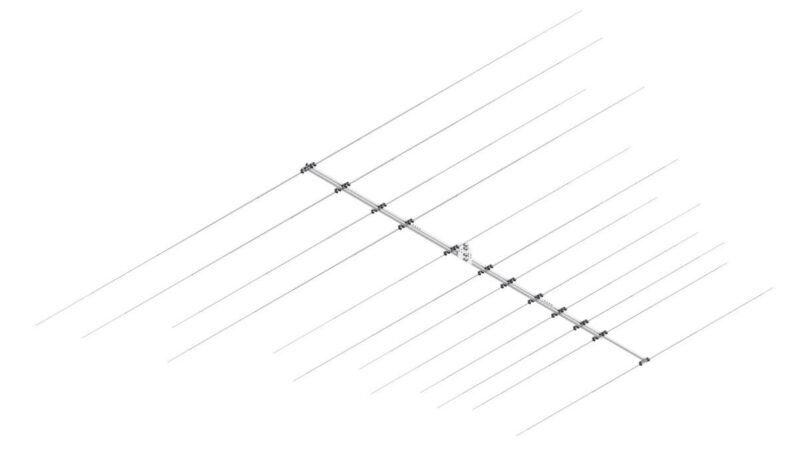
Top Features:
- Fully fed DYA Yagi system (Driven Yagi Array)
- Electrically extremely weather-resistant
- Better than 3-element monoband Yagi on all bands
- Balun already included
Details:
The OBDYA12-5 is a high-performance, fully driven fiveband Yagi antenna, specifically designed for the 14, 18, 21, 24, and 28 MHz amateur radio bands. Unlike a traditional log-periodic antenna, it features 11 driven elements and one parasitic director for the highest frequency bands—resulting in exceptional performance across all bands.
OptiBeam shortwave antennas are engineered using advanced computer-aided simulation techniques and meticulously fine-tuned through comprehensive practical testing. Although the OBDYA12-5 is “fully fed” apart from one parasitic element, it shares nothing in common with log-periodic antennas, which typically suffer from low element count, short booms, and performance limitations in the lowest and highest frequency ranges due to rigid logarithmic design principles.
At the heart of the OBDYA12-5 lies a directly coupled five-element drivercell, with the drivers interconnected by a low-loss, low-impedance square tube phasing line system. A unique parasitic director serves both the 12m and 10m bands while contributing to performance even on the lower frequency ranges. The self-resonant frequency of the longest element acts as a true reflector for 20m, terminated by a short-circuit stub that enhances gain and reception quietness.
The phasing line feeding system is partially crossed (180-degree phase shift) and partially in-phase, depending on the requirements of each element pair—determined by an advanced automated antenna design optimizer. This design ensures maximum gain, optimal radiation patterns, and minimum interaction losses.
The strategic spacing and arrangement of elements, including the minimal physical distance between the parasitic director and the driven area’s foremost element, enable the maximum boom length for the driven section—enhancing overall gain and bandwidth.
The OBDYA12-5 delivers gain figures of 5.08 dBd on 20m, 5.05 dBd on 17m, 5.25 dBd on 15m, 5.25 dBd on 12m, and 5.41 dBd on 10m—equivalent to 12.4 dBi, 12.7 dBi, 13.0 dBi, 13.0 dBi, and 13.2 dBi, respectively. Front-to-back ratios are equally impressive: 26 dB on 20m, 27 dB on 17m, 35 dB on 15m, 27 dB on 12m, and 29 dB on 10m. The antenna maintains an SWR of less than 1.3:1 across all frequency ranges and operates at a standard impedance of 50 Ohms.
The OBDYA12-5 has a maximum element length of 11.22 meters and a boom length of 7.50 meters. It features a turning radius of 6.56 meters and weighs 55 kilograms. Designed for demanding environments, it withstands wind speeds up to 130 km/h, with a wind load rating of 1,200 Newtons, 1.50 m², or 16.13 square feet.
Thanks to its fully driven architecture—referred to as a “DYA” or Driven Yagi Array—the OBDYA12-5 performs like an optimized three-element monoband Yagi on paper and exceeds expectations in real-world operation on all five bands. It’s the ideal solution for DXers, contesters, or everyday use, delivering outstanding gain, precise radiation patterns, and exceptional power handling across the spectrum.
Technical Data
| Product Name | OBDYA12-5 |
|---|---|
| Max. Element Length | 11.22 m |
| Mono-/Multiband | Multiband |
| Number of connectors | 1 |
| Brand | OptiBeam |
| Impedance (Ω) | 50 |
| Supported Bands | 20m, 17m, 15m, 12m, 10m |
| Wind Surface (m²) | 1.5 |
| Weight | 55 kg |
| Number of Elements | 12 |
| Boom length [cm] | 750 cm |
| Front/Back ratio [dB] | 26 (20m) / 27 (17m) / 35 (15m) / 27 (12m) / 29 (10m) |
| Balun Included | Yes |
| Max. Power [W] | 5000 W |
| Polarisation | Horizontal |
| Rotation Radius [m] | 6.56 |
| Boom Size | 40 x 40 mm |
| Antenna Guying | Boom 2 times |
| Antenna Type | Directional Antenna |
| Design of antenna | Yagi |
| Strut | no |
| Antenna mount | Center Mount |
| Max. Mast Diameter [mm] | 50 |
| Connector | SO-239 |
| Gain [dBi] (above ground) | 12,4 (20m) / 12,7 (17m) / 13,0 (15m) / 13,0 (12m) / 13,2 (10m) |
Estimate Price: €2,269.00
Manufacturer: “OptoBeam” Germany.